Free · Cambodia
Visa, e-Visa and Passport: Which Question Comes First?
A practical order for checking Cambodia travel documents
The first question is not simply, “Do I need a visa?”
The useful first question is:
Which passport or travel document will I actually present for this journey?
That answer controls the next checks. A visa rule may depend on the document, nationality, purpose, route, entry point and date. An e-Visa is an application channel for eligible travel; it is not a second passport and it is not a promise of admission. Cambodia e-Arrival is a separate arrival procedure. The permission recorded by immigration reflects the assessment of the journey that actually reaches the border.
This guide gives you a calm sequence for resolving those questions. It deliberately avoids publishing a permanent nationality table. Such a table can become wrong, may omit special travel documents and cannot decide an individual case.
Official information in this edition was checked on 25 October 2026. Reopen the official pages for your own travel date.
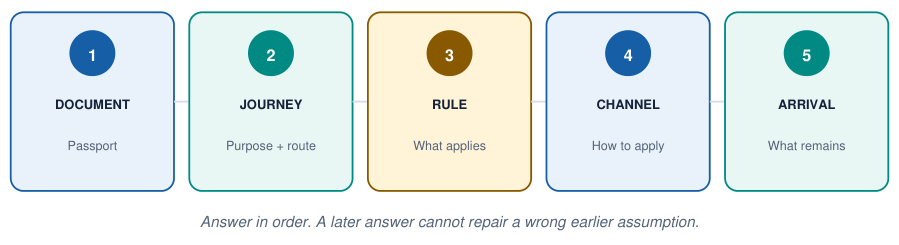
The five-question order
Use the questions in this order. Do not jump to Question 3 simply because a search result offers a prominent application button.
| Order | Question | Evidence that answers it | What the answer does not prove |
|---|---|---|---|
| 1 | Which passport or travel document will I use? | The physical document and its current details | That the holder is visa-exempt or eligible for e-Visa |
| 2 | What is the purpose and shape of this journey? | Your actual itinerary, purpose, dates and entry point | That a tourist product covers work, study, residence or another purpose |
| 3 | Which entry route applies to that document and journey? | Current Cambodian government or diplomatic guidance | That every application channel or border can process it |
| 4 | If advance permission is needed, where is the official application channel? | The official e-Visa site or the relevant Cambodian authority | That a third-party form is government-run, or that approval guarantees entry |
| 5 | What separate arrival and border steps remain? | Cambodia e-Arrival instructions, carrier requirements and immigration | That completing one form replaces the others |
The order prevents a common mistake: choosing a product first, then trying to make the traveller and itinerary fit it.
One-line decision path
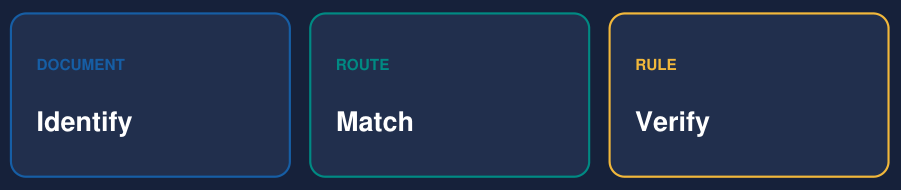
Document → purpose and route → applicable entry rule → official application channel → arrival procedure → border decision
If any link in that chain changes, recheck the later links. A new passport number, different border crossing or changed purpose can make an earlier answer unusable.
Question 1 — Which document will you actually present?
Start with the real document, not a nationality label in a travel forum.
Record only what you need for the decision. Keep full scans and sensitive details in appropriate secure storage.
| Field | Your checked answer |
|---|---|
| Passport or travel-document country/authority | |
| Document type | |
| Name as printed | |
| Expiry date | |
| Document condition checked | ☐ |
| Document changed since any earlier application? | Yes / No |
| Document I will carry and present |
Why the document comes first
Official eligibility tools ask about the travel document because two people departing from the same city may have different requirements. One person may also hold more than one passport, but a visa or e-Visa issued against one document should not casually be used with another.
The official Cambodia e-Visa FAQ says a traveller must travel with the passport for which the e-Visa was issued. That makes document consistency an operational requirement, not a formatting preference.
Check these details before paying or submitting:
- the document number is correct;
- the name and date of birth match the document;
- the nationality/document authority is selected correctly;
- the document will meet the validity requirement for the chosen route;
- the photo page is legible if an upload is required; and
- an old application does not point to a lost, expired or replaced document.
The current official e-Visa visa-type information states a passport-validity requirement of more than six months remaining at entry for the product shown there. Treat that as a requirement to confirm on the current page for the visa type you select, not as permission to generalise across every document and journey.
Stop and recheck if
- the passport will be replaced before travel;
- the booking and passport use materially different names;
- the document is damaged;
- a child’s passport or consent situation is unclear;
- you plan to enter on one passport and leave on another; or
- an earlier approval displays a different document number.
Do not “fix” a mismatch by editing a PDF or typing a note beside it. Use the official correction, status or contact route.
Question 2 — What journey are you asking permission for?
“Going to Cambodia” is not a complete description. Before selecting a visa route, write the journey in one sentence.
I plan to enter Cambodia on [date] at [airport or border], using [document], for [purpose], and leave or take the next authorised step by [date].
Then complete this small scope check:
| Journey fact | Your answer |
|---|---|
| Main purpose | Tourism / business / study / family / work / other |
| Intended arrival date | |
| Intended stay length | |
| Exact first entry point | |
| Air, land or sea | |
| Single entry or a return to Cambodia later? | |
| Activities that may need separate permission |
Purpose is more important than a convenient label
Do not choose a tourist route merely because it is easy to find online. Paid work, formal study, long-term residence or other activities may involve different permission or later processes. This guide does not decide those cases. It helps you notice when the simple tourist question is not the real question.
Ask:
- What will I actually do?
- Which Cambodian authority describes permission for that activity?
- Does the application channel I am viewing cover it?
- What must happen before travel, at entry and after entry?
If the purpose is unclear, resolve it before treating an application fee as the next step.
The route matters too
The official e-Visa FAQ warns that not every border checkpoint supports e-Visa and tells travellers to check before applying. Therefore, “eligible for an e-Visa” and “able to use that e-Visa at this checkpoint” are different findings.
Write the checkpoint’s official name, not only the nearest city. A route described casually as “the Thailand border” or “the Siem Reap crossing” is not precise enough for a document decision.
Question 3 — Which entry rule applies?
Now determine whether the chosen document and journey use:
- a visa exemption or other authorised visa-free arrangement;
- a visa obtained in advance;
- an eligible e-Visa route;
- a visa-on-arrival route where available and applicable; or
- another process specified by Cambodian authorities.
These labels are not interchangeable.
Do not use a copied nationality table as the final answer
A copied list may be:
- out of date;
- written for tourism only;
- limited to ordinary passports;
- silent about residence, work or study;
- based on a different entry point;
- missing a temporary arrangement and its end date; or
- describing visa eligibility rather than admission.
Use a copied list only as a prompt to open the current official source. Record the source and date you checked.
| Decision | Your verified answer | Official source | Checked on |
|---|---|---|---|
| Rule for my exact document | |||
| Rule for my purpose | |||
| Maximum or authorised stay described by that route | |||
| Entry point can process the route | |||
| Advance action required | |||
| Remaining uncertainty |
Temporary arrangements need an end-date check
Cambodian authorities may publish time-limited measures. A dated measure is not a permanent nationality rule, and an older search snippet may remain visible after the qualifying period has ended. Open the current official notice, compare its dates with the planned journey and do not rely on the snippet alone.
When you see a temporary measure, record:
- who is covered;
- the eligible documents;
- the permitted purpose;
- the qualifying arrival or stay dates;
- the entry points or route limits; and
- the official end date.
If your trip falls near the boundary, reopen the notice shortly before travel and keep a current copy of the official guidance—not a cropped social-media post.
Question 4 — Is e-Visa the rule or merely the channel?
Cambodia’s official e-Visa site describes e-Visa as an online platform for applying for a Cambodian visa. That distinction matters:
The visa is the permission product; e-Visa is the electronic application and certificate route for eligible cases.
An e-Visa does not mean every traveller needs one, every visa type is available online, or every border point accepts it.
Use the official site
The official address is:
Open the official Cambodia e-Visa service
Check the host name before entering passport or payment details. A paid assistance site may offer a genuine private service, but it is not transformed into the Cambodian government merely by using flags, official-looking colours or the phrase “Cambodia visa.”
Before submitting, use this six-part verification:
- Site — Is the browser on the official
evisa.gov.khdomain? - Type — Is the displayed visa type suitable for the actual purpose?
- Document — Does every identity field match the passport you will carry?
- Entry point — Does the current official list support e-Visa use there?
- Timing — Is there enough time for processing, correction and travel disruption?
- Evidence — Can you retrieve the application status and certificate through the official system?
The official site currently advertises processing within three business days for the e-Visa product shown. That is a service statement, not a reason to apply at the last minute. Weekends, incorrect data, document problems, payment issues or a need for clarification can consume your buffer. Use the current official timing and build additional time you can afford.
What approval still does not prove
An e-Visa approval does not by itself prove:
- the passport is still valid and undamaged;
- the airline or carrier will accept every document at check-in;
- the traveller is using an authorised entry point;
- the journey’s actual purpose matches the permission;
- Cambodia e-Arrival has been completed where required;
- the border will admit the traveller; or
- the traveller may remain until the date on a return ticket.
Keep approval language precise: issued, valid for the stated conditions, and presented for inspection are safer descriptions than “guaranteed entry.”
Question 5 — What remains after the visa question?
Even when the visa position is clear, the arrival job is not finished.
Cambodia e-Arrival is separate
The official Cambodia e-Arrival service is at:
Open the official Cambodia e-Arrival service
It handles the digital arrival information requested by the system. It is not the same as the e-Visa application and does not turn a passport into a visa.
For the full boundary between e-Arrival, visa and admission, use the companion free guide KH-PF-01 — Cambodia e-Arrival Is Free and Is Not a Visa. This guide focuses on choosing the document and entry route before you reach that stage.
The carrier performs its own document check
An airline, bus operator or other carrier may ask for evidence relevant to boarding. The carrier’s check is not the same as Cambodia’s immigration decision, but a missing or mismatched document can stop the journey before the border.
Keep these available in the form the current instructions require:
- the passport or travel document used in the application;
- visa/e-Visa evidence if applicable;
- e-Arrival confirmation if applicable;
- onward or return evidence where requested;
- accommodation or contact information where requested; and
- any purpose-specific document required for the route.
Immigration decides admission and records the stay
At entry, inspect the official record issued or made available after admission. Do not infer the authorised stay from:
- the visa’s validity window;
- the date of a hotel reservation;
- the date on a flight booking; or
- the maximum duration mentioned in a general article.
The permission actually granted at entry controls. If a material detail appears wrong or unclear, ask the relevant authority rather than choosing the date you prefer.
Three worked examples
Example 1 — The traveller chooses the website before the route
Mara searches “Cambodia visa,” opens a polished paid form and begins entering details. She has not yet decided whether she will fly to Phnom Penh or enter overland after visiting Thailand.
Problem: The entry point can affect whether the selected electronic route is usable. She is solving the application-channel question before the itinerary question.
Better sequence:
- confirm the passport she will use;
- decide the actual entry point;
- identify the rule for that document and purpose;
- verify the entry point on the current official e-Visa information;
- then use the official application channel if it applies.
Example 2 — A new passport after e-Visa approval
Daniel receives an e-Visa and later replaces his damaged passport. His name and nationality remain the same, so he assumes the approval automatically follows him.
Problem: The official FAQ says the traveller must use the passport for which the e-Visa was issued. The document number is part of the decision.
Better sequence: Use the official status/contact route before travel. Do not edit the certificate or rely on a verbal explanation at check-in.
Example 3 — Visa-free does not mean form-free or decision-free
Lina verifies that a current official arrangement covers her document and short tourist stay. She concludes that she needs no further preparation.
Problem: A visa exemption answers only the visa-route question. It does not remove passport checks, applicable e-Arrival steps, carrier requirements or the immigration decision.
Better sequence: Record the official exemption source and dates, then complete the separate arrival and boarding checklist.
The ten-minute final check
Complete this after the route is stable and again shortly before departure.
- [ ] I know which passport or travel document I will present.
- [ ] Every application and booking uses the correct document details.
- [ ] I described the real purpose of the trip, not the easiest visa label.
- [ ] I identified the exact airport or border checkpoint.
- [ ] I checked the rule for my document, purpose, route and date on an official source.
- [ ] If the measure is temporary, I recorded its official end date.
- [ ] If I need an e-Visa, I used
evisa.gov.khand verified that the checkpoint supports it. - [ ] I saved the official application/status route and certificate where applicable.
- [ ] I checked the separate Cambodia e-Arrival procedure at
arrival.gov.kh. - [ ] I will inspect the permission and period of stay actually recorded at entry.
Your one-page decision record
| Item | Final checked answer |
|---|---|
| Document used | |
| Purpose | |
| Entry point and date | |
| Entry rule | |
| Official source and check date | |
| Application channel, if needed | |
| Application/status reference stored securely | |
| e-Arrival action | |
| Question to resolve before departure | |
| Recheck date |
If one row remains uncertain, name the authority or carrier that can answer it and set a deadline. Uncertainty written down is safer than a confident guess hidden inside a rushed application.
Official sources checked
Checked on 25 October 2026:
- Cambodia e-Visa — official government site
https://www.evisa.gov.kh/ - Cambodia e-Visa — visa type information
https://www.evisa.gov.kh/information/visa_type/4 - Cambodia e-Visa — official FAQ
https://www.evisa.gov.kh/FAQ - Cambodia e-Visa — check and change
https://www.evisa.gov.kh/check_change - Cambodia e-Visa — about the official service
https://www.evisa.gov.kh/about - Cambodia e-Arrival — General Department of Immigration
https://arrival.gov.kh/ - General Department of Immigration
https://immigration.gov.kh/
Editorial scope boundary
This free guide solves one small problem: the order in which a traveller should check passport, purpose, route, visa channel and arrival procedure. It does not decide individual eligibility, provide a visa service, guarantee boarding or admission, or replace advice from Cambodian authorities and the relevant carrier.
Location references
These Google Maps searches identify the places discussed here. Confirm the exact address and current access separately.